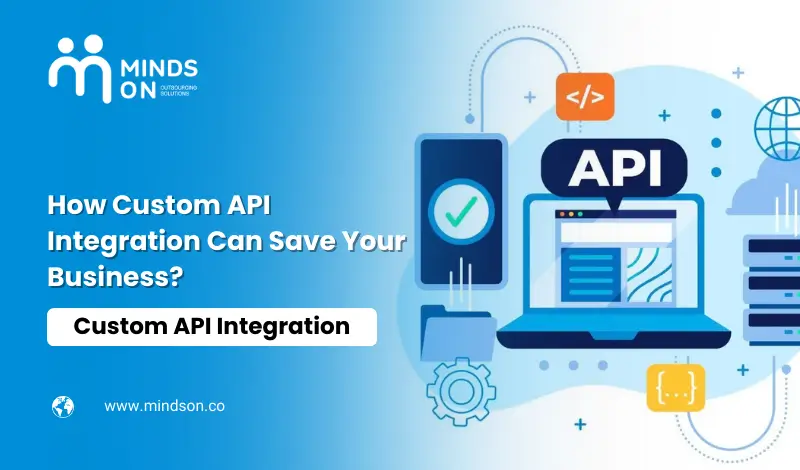
How Custom API Integration Can Save Your Business?
The difference between a thriving enterprise and a stagnant business often comes down to one thing: connectivity. Gone are the days when software lived in silos. Today, the most successful companies operate like a well-oiled machine where every part communicates seamlessly. This is made possible through api integration and professional api development. Whether you are looking to automate your workflows, secure your payments, or enhance user experience, custom APIs are the secret weapon that can save your business thousands of hours and millions in revenue.
The Foundation of Modern Growth: API Development and Integration
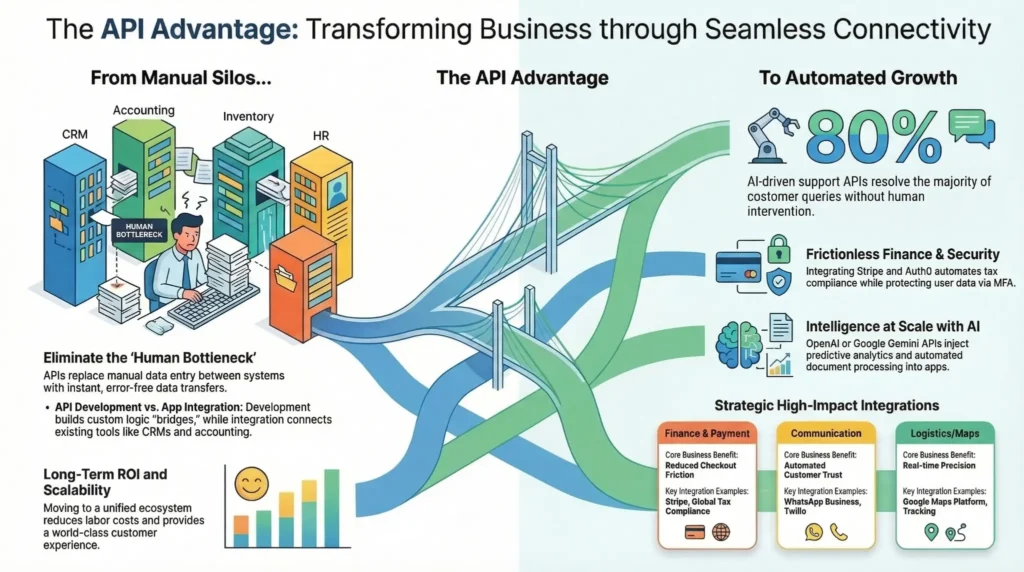
To understand how APIs save your business, we must first distinguish between api development and app integration. API development is the process of building a custom “bridge” specifically designed for your unique business logic. It allows your internal systems to share data securely and efficiently. On the other hand, app integration refers to the practice of connecting existing software like your CRM, accounting tools, and marketing platforms to work as one unified system. When a business invests in enterprise application integration, they are essentially removing the “human bottleneck.” Instead of employees manually copying data from an email into a spreadsheet, or from a website into a billing system, the API handles the transfer instantly and without error. This level of automation is no longer a luxury; it is a necessity for any startup or established firm looking to scale in a competitive market.
Revolutionizing Transactions with Payment & Finance APIs
One of the most immediate ways to see the value of integration is through Payment & Finance APIs. In the past, handling global transactions was a logistical nightmare involving high fees and complex security protocols. Today, integrating the stripe api has become the gold standard for businesses worldwide. The stripe api does more than just “accept credit cards.” It provides a robust framework for handling subscriptions, managing fraud detection, and automating tax compliance across different borders. By implementing professional app integration for your financial stack, you reduce checkout friction, which directly increases your conversion rates. When a customer can pay effortlessly and securely, they are far more likely to return. Furthermore, these APIs provide real-time data syncing with your accounting software, ensuring your financial records are always accurate without a second of manual data entry.
Enhancing Interaction with Communication & Security APIs
Customer trust is the currency of the digital age. This is where Communication & Security APIs play a pivotal role. Security-focused APIs, such as Auth0 or Firebase Auth, ensure that user data is protected through multi-factor authentication and encrypted login processes. This prevents costly data breaches that could otherwise bankrupt a growing company and destroy its reputation. Simultaneously, communication APIs like Twilio or the WhatsApp Business API allow businesses to reach customers where they are most active. Imagine a system where, the moment a client books a service on your website, they receive an automated, branded WhatsApp message with their appointment details. This isn’t just “cool tech” it’s a high-level api integration strategy that reduces “no-shows” and improves customer satisfaction. By automating these touchpoints, your staff can focus on high-value tasks instead of sending manual reminders.
Intelligence at Scale: Artificial Intelligence (AI) APIs
The most significant shift in api development recently has been the accessibility of Artificial Intelligence (AI) APIs. You no longer need a team of data scientists to build AI features. By integrating APIs from OpenAI, Google Gemini, or Anthropic, you can inject “brains” into your business applications. These Artificial Intelligence (AI) APIs can be used to analyze customer behavior, predict stock shortages, or even automate complex document processing. For businesses handling large volumes of data such as those in BPO or medical billing AI-driven OCR APIs can scan thousands of invoices in minutes, identifying errors that a human eye might miss. This level of enterprise application integration ensures that your business remains agile and data-driven.
Transforming Service: APIs to Automate Your Customer Support
Customer support is often a major cost center for businesses. However, using APIs to automate your customer support can turn this department into an efficiency engine. By connecting your website to AI-driven support APIs, you can resolve up to 80% of common customer queries such as “Where is my order?” or “How do I reset my password?” without any human intervention. These automated systems work 24/7, providing instant responses that keep customers happy. When a query is too complex for the AI, the app integration ensures a “warm handoff” to a human agent, providing them with the full context of the conversation. This reduces resolution time and allows your team to handle a much higher volume of inquiries without increasing your headcount.
Location-Based Precision with Google Maps Platform
For businesses that rely on logistics, local services, or physical storefronts, the Google Maps Platform is an indispensable tool. It is much more than just a map on a “Contact Us” page. Through advanced api integration, you can provide users with real-time delivery tracking, distance-based pricing, and address autocomplete features that prevent shipping errors. By utilizing the Google Maps Platform, you enhance the user experience by making it incredibly easy for customers to interact with your physical or local services. For example, a service-based business can use these APIs to automatically assign the nearest technician to a job site, saving on fuel costs and improving response times.
The Long-Term ROI of Enterprise Application Integration
How Custom API Integration Can Save Your Business is not just about the technology it’s about the freedom to scale. When you move away from fragmented tools and move toward a unified ecosystem through enterprise application integration, you are choosing efficiency over chaos. Whether it is the security of Communication & Security APIs, the financial power of the stripe api, or the futuristic capabilities of Artificial Intelligence (AI) APIs, the goal remains the same: to build a business that works for you, rather than you working for your software. Professional api development is an investment that pays for itself by reducing labor costs, eliminating human error, and providing a world-class experience for your customers.
Categories
Latest Posts

Hire Node.js Developers to Build High-Performance Web and App Solutions
March 10, 2026
No Comments
Read More »