
Roles of Web and Mobile App Developers in Modern Digital Products
Mobile app development plays a critical role in today’s digital-first economy, where business success is directly tied to the quality, performance, and scalability of digital products. We recognize that every high performing application is built by a well-structured development team in which mobile app developers and web developers have clearly defined yet closely interconnected responsibilities. This article delivers a comprehensive and in-depth analysis of these roles, highlighting their core responsibilities, technical expertise, collaboration models, and their direct impact on sustainable business growth.
The Core Responsibilities of Web Developers
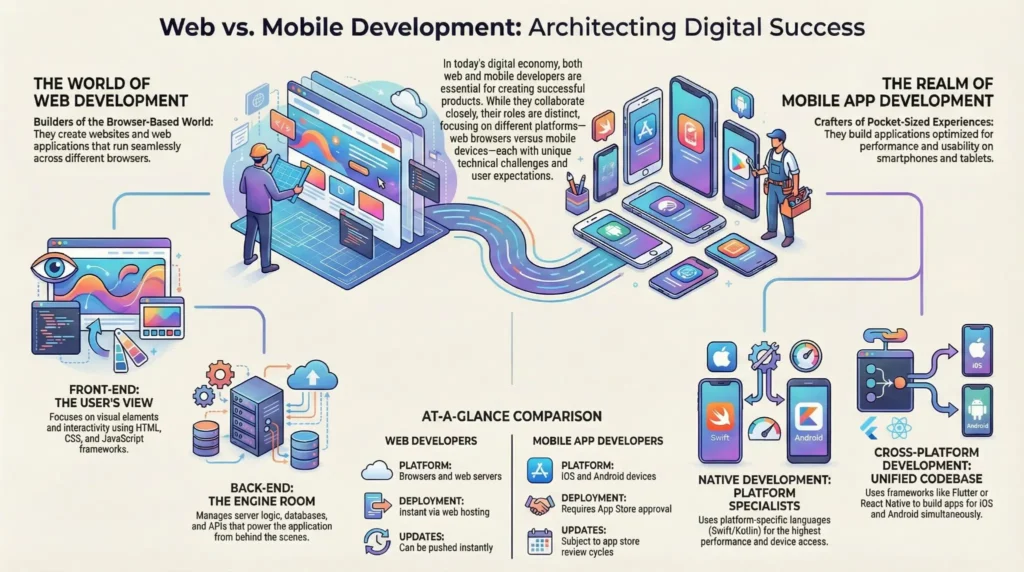
Web developers are responsible for designing, building, optimizing, and maintaining websites and web-based applications that operate seamlessly across browsers and devices. We focus on delivering fast-loading, secure, and scalable web solutions that align with business objectives and user expectations.
Front-End Web Developer Responsibilities
Front-end web developers specialize in creating the visual and interactive components of websites. We ensure that users experience intuitive navigation, responsive layouts, and engaging interfaces. This role demands expertise in HTML, CSS, JavaScript, and modern frameworks such as React, Angular, or Vue.js. Front-end developers translate UI/UX designs into functional code while ensuring cross-browser compatibility, accessibility compliance, and optimal performance.
Back-End Web Developer Responsibilities
Back-end web developers manage the server-side logic that powers web applications. We design robust architectures, manage databases, and develop APIs that connect front-end interfaces with business logic. Proficiency in languages such as PHP, Python, Java, Node.js, and Ruby is essential. Back-end developers also handle authentication, authorization, data processing, and system integrations, ensuring reliability and scalability.
Full-Stack Web Development Capabilities
Full-stack developers combine front-end and back-end expertise to deliver end-to-end web solutions. We leverage this versatility to accelerate development cycles, reduce communication gaps, and ensure cohesive application architecture. Full-stack developers are particularly valuable in agile environments and start up ecosystems where flexibility and speed are critical.
Defining the Role of Mobile App Developers
Mobile app developers focus on creating applications optimized for smartphones and tablets. We build mobile experiences that are performant, secure, and aligned with platform-specific guidelines. Mobile development requires a deep accepting of operating systems, hardware constraints, and user behaviour patterns unique to mobile devices.
Native Mobile App Developer Responsibilities
Native mobile app developers build applications specifically for platforms such as iOS and Android. We use Swift or Objective-C for iOS development and Kotlin or Java for Android development. Native development allows us to fully leverage device features such as GPS, camera, biometrics, and push notifications, resulting in superior performance and user experience.
Cross-Platform Mobile App Development Roles
Cross-platform developers create applications that run on multiple platforms using a single codebase. We utilize frameworks such as Flutter, React Native, and Xamarin to reduce development time while maintaining near-native performance. This role requires balancing platform consistency with performance optimization and UI adaptability.
Mobile App Performance and Security Optimization
Mobile app developers are responsible for ensuring smooth performance under varying network conditions and device specifications. We implement competent memory management, offline functionality, and secure data storage. Security measures such as encryption, secure authentication, and compliance with platform policies are integral to this role.
Key Differences Between Web and Mobile App Developers
While both roles aim to deliver exceptional digital experiences, their technical focus and constraints differ significantly. We recognize these distinctions to build balanced development teams.
Aspect | Web Developers | Mobile App Developers |
Platform | Browsers and web servers | iOS and Android devices |
Languages | HTML, CSS, JavaScript, backend languages | Swift, Kotlin, Java, Dart |
Performance Constraints | Browser and server-based | Device hardware and OS-based |
Deployment | Web hosting and servers | App Stores (Apple & Google) |
Updates | Instant deployment | App store approval cycles |
Collaboration Between Web and Mobile App Developers
Successful digital products are built through collaboration. We ensure that web and mobile app developers work closely with designers, QA engineers, DevOps teams, and product managers. Shared APIs, consistent design systems, and unified business logic enable smooth cross-platform experiences.
API-Driven Development Approach
We rely on API-first development to bridge web and mobile platforms. RESTful and GraphQL APIs allow both web and mobile applications to access shared backend services, ensuring consistency in data and functionality.
Agile and DevOps Integration
Web and mobile developers operate within agile frameworks to deliver incremental value. We integrate CI/CD pipelines, automated testing, and cloud infrastructure to accelerate releases while maintaining quality and stability.
Essential Skills for Modern Web and Mobile App Developers
We prioritize developers with a blend of technical expertise and problem-solving capabilities. Key skills include:
- Strong understanding of UI/UX principles
- Proficiency in modern frameworks and libraries
- Experience with cloud platforms and scalable architectures
- Knowledge of security best practices
- Ability to optimize performance and responsiveness
Business Impact of Skilled Web and Mobile App Developers
Web and mobile app developers directly influence user engagement, conversion rates, and brand credibility. We see measurable business outcomes when applications are fast, intuitive, and reliable. High-quality development reduces maintenance costs, improves customer retention, and assists rapid scalability.
Future Trends Shaping Web and Mobile App Development Roles
The roles of web and mobile app developers continue to evolve. We are adapting to emerging trends such as:
- Progressive Web Apps (PWAs) bridging web and mobile experiences
- AI-driven personalization and automation
- Serverless and micro services architectures
- Increased focus on accessibility and performance optimization
Conclusion: Building Digital Excellence Through Specialized Development Roles
We believe that understanding the distinct roles of web and mobile app developers is essential for building scalable, high-performing digital products. By aligning technical expertise with business goals and fostering cross-functional collaboration, organizations can deliver exceptional user experiences across all platforms. Skilled web and mobile app developers are not just implementers they are strategic contributors to long-term digital success.
Categories
Latest Posts